

Announcement and
build up to launch
For what became
the second best selling console of all time (according to wiki, I’m pretty sure
it’s the best selling) the DS had quite humble beginnings. Even Nintendo didn’t
hold out much hope. Despite the underperformance of the N64 and Gamecube,
Nintendo still had a vice like hold over the portable gaming market with the
Gameboy range. However that was about to be challenged by the arrival of the
Sony’s PSP which offered near PS2 levels of graphical and aural fidelity.
The DS was announced
in early 2004 (21st of January is about as accurate as I can
predict) and the hardware shown a few weeks later. With its dual screens,
microphone and stylus controlled touch pad it was unlike any other console out
there. It was ugly and underpowered and the subject of a lot of gamer scorn
especially when compared to the high tech PSP. It felt like Nintendo was afraid
of losing its only stronghold, the handheld market, to Sony and had rushed out
a console to challenge it. Even Nintendo didn’t seem confident, announcing that
it wasn’t a successor to the Gamecube or the Gameboy line, although it was
backwards compatible with GBA software. To quote an article from Eurogamer from
around the time of the DS announcement:
‘Nintendo
president Satoru Iwata has publicly stated that the company will be happy if
just ten per cent of people find the DS interesting enough to buy’
The last time
Nintendo sounded this unsure about a console was the Virtual Boy.
At E3 2004
Nintendo decided to show how the unique features of the DS could bring new
ideas to gaming. A strong showing garnered some positive public perception
although there was still concern that what was shown was nothing more than a
few tech demos and good ideas rather than fully fleshed out games. Showing
Super Mario 64 running on the machine showed that it was quite capable
technically but still far from matching the power of the PSP.
Launch
The Nintendo DS was
released across North American and Japan in winter 2004. PAL territories had to
wait until spring 2005.The DS just beat the PSP to store shelves in all
territories. Strangely for a Japanese product it launched in North America
first. It was quite a subdued launch in comparison to most modern console
launches with their massive queues outside stores at midnight. Many places
reported being sold out one launch day but my own experience was of strolling
into a very quiet Gamestop on my lunch break and picking one up no problem.
Initial sales were quite good and enough for Nintendo to be satisfied. Half a
million consoles were sold in the first week in America with a million sold by
the year end a month later. Despite the subdued launch it still went on to
break console launch sales records in many places although the fact that it was
well stocked might have been a contributing factor. In comparison the PSP
worldwide launches were much more hectic with shipments being sold out in hours
and a high number import consoles in European regions (which lead to Sony
calling out its lawyer brigade but that’s another story).
The launch line
up for the DS was surprisingly good. Super Mario 64 DS was the big launch title
and while technically impressive was ultimately a disappointing port due to the
lack of analogue controls and some late game breaking bugs. The best games of
the launch were the games that showed off the DS’s unique control inputs.
Warioware Touched! and Project Rub were the two that best showed off the unique
touch screen and microphone interface of the DS. Despite being rather short
they were a hell of a lot of fun. Puzzle game fans were well served with Mr.
Driller and the superb Zoo Keeper, the previously free flash game made a
surprisingly great fit on the DS. One title that gets over looked is Polarium,
a very minimalistic puzzle game that was released at a budget price. DS games
were supposed to come at two price points but Polarium is the only one I recall
being released at this budget price. Unfortunately the excellent rhythm game Daigasso!
Band Brothers was only available for the Japanese launch although the sequel
Jam with the Band did eventually get a surprise late European release in 2010
 |
| Yes, Project Rub was kind of weird but in the best way! |
Of course there
was a lot of crap in the launch line up as well. Many were ports of older games
(Rayman DS) or mobile phone games (Asphalt GT) with tacked on touch screen
controls. Tacking on touch screen and microphone features unfortunately became
common place until developers understood the hardware. Then there were the
truly horrifyingly bad games like Sprung and Ping Pals (a rare mishap by
WayForward Technologies). Overall it
wasn’t a bad launch line up although again comparing it to the PSP launch line
up it was quite lacking. The PSP had what I consider to be one of the most
impressive launch line ups of any console.
Post Launch
Then the
inevitable post launch drought settled in. I find it funny when people complain
there’s not enough new games on the WiiU and before that the 3DS as if it’s
something out of the ordinary where every console experiences a drought of
quality releases after launch. The DS was no different. There were a few long
quiet months with nothing of any worth appearing on the console.
Yoshi’s Touch
and Go was the first big game out of the gates and proved to be a huge
disappointment. It was nothing more than a tech demo stretched out into a full
release game. Things would have been bad for the DS if it the PSP wasn’t having
similar problems and suffered from a raft of terrible ports of PS2 games.
All that changed
around in the Autumn of 2005. Konami released Castlevania: Dawn of Sorrow on
the DS, a wonderful follow up to the DS’s Aria of Sorrow. Despite having some
tacked on touch interface and using that stupid ‘DS’ naming scheme of early
games Dawn of Sorrow was one of the best games in the long running franchise.
Dawn of Sorrow would be the first of many excellent Castlevania adventures on
the DS.
 |
| Remember when Castlevania used to be this awesome? |
Nintendo
followed up its successful Advance Wars series on the GBA with Advance Wars
Dual Strike. While it didn’t add much to the Advance Wars formula it was still
a must own for any strategy game fan.
Puzzle fans were
satiated with Meteos. A strange puzzle game that used touch screen controls, it’s
a game that really wouldn’t have worked on any other system. Designed by Tetsuya
Mizuguchi, it was a good puzzler but not a patch on his other recent puzzle
game Lumines on the PSP.
In a big gamble
that paid off Capcom decided to release a remake of one of its visual novel
series and bring it to the West. Visual novels had always been popular in Japan
but the genre had died off with text based adventures in the West. A hilarious
comedy that was also a harsh satire of the Japanese legal system Phoenix
Wright: Ace Attorney became a surprise critical and commercial hit on the
system. A localisation by the
translation legend Alexander O. Smith helped the game resonate with western
gamers and made Phoenix Wright into a successful franchise. It opened the doors
for many more visual novels such Hotel Dusk and Theresia.
 |
| Courtroom justice was never sweeter. Or funnier |
It was the
release of Kirby: Canvas Curse, or Power Paintbrush in Europe, that really
showed the potential of touch control. Canvas Curse remains a unique game even
to this day. The player has limited control over the spherical ball of pinkness
and must instead rely on painting a path out for Kirby to traverse each
hazardous stage. Kirby: Canvas Curse remains one of the best games on the
system and showed developers how to utilise touch controls instead of
shoehorning them in.
However the
arrival of good software really wasn’t what pushed the DS into mass market
mainstream appeal.
Nintendo DS
mania!
Over in Japan a
game released in April 2005 was making the headlines. Nintendogs was a pet simulator
and had a received a rare (at the time) 40/40 score from Famitsu. It was wildly
popular with children and especially females. Sales of the DS increased rapidly
on its release. It was the same story when it was released in the west. The DS
became one of the hottest gifts for Christmas 2005 but it proved only to be the
beginning of DS mania.
 |
| I wanted to like this game but the dog just didn't understand my dublin accent :( |
The popularity
of the DS grew even further with the release of Dr. Kawashima's Brain Training:
How Old Is Your Brain? on May 2005 in Japan and Spring/Summer of 2006 in the
West. Nintendo had managed to entice the untapped female market with Nintendogs
and shrewdly targeted an older market. Brain Training was popular with people
of all ages. It wasn’t uncommon to see people of 50+ playing Brain Training on
their DS. It became one of the DS’s biggest sellers with close to 19 million
sales worldwide according to Wikipedia. With just two games Nintendo had
cleverly introduced gaming to people outside of the usual 10-25 year age range
that normally would never have considered gaming to be anything other than a
waste of time.
It wasn’t until
the release of the DS Lite that the DS really hit its peak. Released in March
2006 and June 2006 in the rest of the world, the DS Lite was the console that
the DS should always have been. Smaller,
lighter and much more compact it’s one of the nicest looking and best designed
consoles ever made. People went crazy
for it. Nintendo could not keep up with demand in Japan where the DS Lite
constantly sold out on the day shipments arrived in shops and this continued
for months after release. Although not as bad in the West there were still
cases of shipments selling out and shortages during the Christmas period. The
arrival of the Pokemon juggernaut with Diamond and Pearl in 2007 meant
continuing DS Lite shortages in 2007. The DS had become the toy every kid wanted.
 |
| A thing of beauty |
Piracy
Unfortunately
the DS like the PSP was hit by piracy pretty early in its lifespan. Although I
can’t put an exact time frame on when DS flashcarts started to be made it looks
to be around 2006 when they first started to hit the market. With a cheap Chinese
made adapter and a micro SD card any owner with an internet connection had
access to the entire DS library. With none of the complex soldering or firmware
flashing required on other platforms quite literally a child could set up their
DS to play pirated software. By the following year anyone could go to a local market
and find a dodgy person selling overpriced flashcarts filled with pirated
games. You would be more likely to see a child with a flashcart in their DS
than a genuine game.
 |
| The Chinese ruin everything :P |
Unfortunately
piracy stunted the DS market very far too early and many developers abandoned
the platform to work on mobile or PSP in the case of Japanese developers. By
2008 only big games, like Dragon Quest IX or Pokemon, or niche publishers with
dedicated fanbases, like Atlus or XSeed, could survive on the platform. While
the DS flashcarts did lead to some fantastic homebrew and fan translations of
games such as Nanashi no Game and Tales of Innocence the fact remains that
these games probably didn’t get English releases in the first place due to the
rampant piracy on the system. In the end many Japanese games such as Blood of
the Bahamut and ASH: Archaic Sealed Heat have remained untranslated and
unreleased to westerners.
The Games and
Legacy of the DS
The huge install
base of DS users and the low cost of making games on the system lead to a publishing
eco system similar to the Playstation and Playstation 2. With such a low
barrier of entry many small experimental games could be profitable with only
minor sales. Many of these were made for the Japanese market but small
publishers were willing to take risks publishing these games in the west. The
fact that the system was region free meant that word of mouth would spread
about great Japanese only DS games. Boing! Docomodake, Touch Detective and
their ilk would probably never have seen the light of day if it wasn’t for this
publishing eco system and import scene. Famously the superb rhythm action title
Osu! Tatakae! Ouendan! proved so popular
with importers that Nintendo westernised it as Elite Beat Agents.
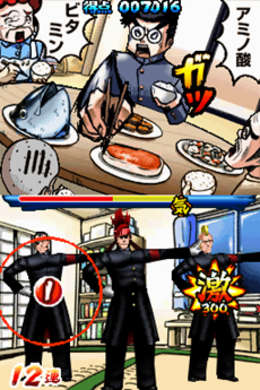 |
| 'Linda Linda!'. You need to play this game! |
New game genres
and concepts were introduced by the DS and some old ones were resurrected.
There’s really no doubt that the DS and its touch screen were precursors to
today’s touch enabled mobile gaming. Considering Apple’s aversion to videogames
it might be a happy coincidence that the touch panel on the iPhone lent itself
to similar game types but no doubt a generation of developers were inspired by
ideas that started on the DS. The 3DS street pass idea began as a popular
feature in Dragon Quest IX where users could share maps with each other through
Wi-Fi. While the street pass feature didn’t make sense outside of Japan where
everyone was playing Dragon Quest IX, it evolved into the much better
implemented street pass feature of the 3DS.
As mentioned the
visual novel that was so popular in Japan was introduced to the west by Phoenix
Wright and was followed by games like 9 Hours 9 Persons 9 Doors and Time
Hollow. The genre has also gained quite the niche for itself on the PC. Then there’s
the first person dungeon crawler. Despite having died in the West with the
Wizardry series first person dungeon crawlers remained popular in Japan. Etrian
Odyssey, released by Atlus in 2007, brought the old school dungeon crawler back
into the limelight and added its own modernised twist. It’s quite simply one of
the best RPGs ever made and led the way for many others in the genre such as
the excellent Shin Megami Tensei Strange Journey and might even have had an
influence on the success of Legend of Grimrock.
 |
| Etrian Odyssey really is amazing. It's been reprinted by Atlus as well as it's two sequels so no excuse no to pick it up as well as Etrian Odyssey 4 coming to 3DS! |
The DS was the
platform to own if you liked RPGs. People complain that there’s no good Japanese
RPGs anymore but that’s because they are playing the wrong platform. Old school
classics like the Dragon Quest games and Chrono Trigger were joined by highly
experimental RPGs such as The World Ends with You and Contact. Even the staid unchanging
Dragon Quest series decided to change things up with Dragon Quest IX being one
of the most progressive and forward thinking RPGs in recent years. Of course
there was Pokemon and if you were sick of that there was always the equally
good Dragon Quest Monsters. Strategy RPG fans were well served with the likes
of Front Mission and Shin Megami Tensei Devil Survivor. Even rogue-like games
were represented with Izuna the Unemployed Ninja and Shiren the Wanderer. Hell,
there’s even soccer RPGs in the form of the Inazuma Eleven games.
 |
| If you play one Dragon Quest game, make sure it's DQV |
The DS’s biggest
success however was introducing people to gaming that may never have considered
gaming before. Finding a girl gamer my age is about as rare as a legendary
pokemon but the younger generation has a lot more females that game and it’s
pretty much a direct result of the DS and games like Nintendogs. Brain Training
may have also been responsible for introducing older people to games. While
Apple have now taken that baton from Nintendo it was Nintendo that really
started making gaming more acceptable to people that previously looked down on
it.
The success of
the DS brought Nintendo out of the rut it was in and inspired them to try
something different with the Wii. If it wasn’t for the DS, Nintendo might still
be the has-been it was in the early 2000’s except even worse with a weaker
handheld market to fall back on. I also believe New Super Mario Bros. DS was
the game that made Mario popular again. Despite it being far and away the most
disappointing of the main series Mario games it became possibly (reports are a
bit divided on this) the best selling game on the system. Now Mario merchandise
is everywhere.
To Cap it off
 |
| Canvas Curse! |
It’s amazing how
a console that seemed like such a rush job could become so successful. I doubt
even Nintendo expected the success they had with the DS. What I love about the
DS is the wide variety of software on the system that spans so many genres. It’s
got one of the best and most diverse libraries of any system and that for me
makes it my best system of all time (I’m sorry Super Nintendo). With game
budgets spiralling ever higher and the risk adverse nature of the games
industry it was nice to have that little handheld niche of creativity. I’m just
glad the 3DS seems to be following in the footsteps of the DS.





.png)


